
Bonhoeffer: Pastor. Spy. Assassin
Rating: 9/10
Director: Todd Komarnicki
Writer: Todd Komarnicki
Style: Drama/ Thriller/ Biopic
Time: 2 hours, 12 minutes
Rating: PG-13

Review by Mike Szymanski
Great filmmakers still find true stories in past heroes that have yet to be told. Who could possibly imagine that someone of heroic proportions involved in WWII has not already been canonized in a great movie.
Komarnicki became fascinated with the German Lutheran pastor Dietrich Bonhoeffer who was an outspoken anti-Nazi as he watched Hitler grow in popularity in his country. He previously wrote “Sully” directed by Clint Eastwood and starring Tom Hanks as the pilot who successfully landed a damaged plane in the Hudson River.
Bonhoeffer was a neo-orthodox theologian and a key founding member of the Confessing Church. His 1937 writings about a Christians role in the secular world in the book “The Cost of Discipleship” is still a big influence today.
The film starts rather biographical in 1914. Even at the start, heavy deep musical chords leading to a cute kid’s face close-up. showing a sense of foreboding. That is the case with the music throughout.
The darling Phileas Heyblom is the young version of Dietrich, and he’s a promising actor. He pretends to be invisible as his older brother chases him around the house while they are wearing their leather-hosen pants. Dietrich has a sister Sabine played by Lisa Hofer who is radiant in every scene she does.
Throughout the rest of the film, Dietrich is played by a formidable actor Jonas Dassler, who completely embodies the role and even looks like the real character when he puts on a pair of glasses.
There is a wonderful sequence when this guy who has decided to become a man of the cloth, visits American and is taken to a black church. He then discovers jazz, and is transfixed by the power of music and how people celebrate religion in different ways. It is particularly delightful to watch Dietrich gape with amazement when he walks into an all-black club and then he is invited to play the piano with them.
David Jonsson plays Frank Fisher, the American who introduces him to black culture. He is also introduced to discrimination when his friend is not allowed to stay in a hotel when they try to get a room together and he gets punched in the face.
“This kind of hate takes something stronger than a punch,” Dietrich says.
When he returns to his homeland, Dietrich is shocked how the loud-mouthed Austrian has taken over the country and rounded up the Jews. “You speak in nightmares,” he says. “Rumor and rage can’t rule the day.”
His father answers, “Unless the day is already lost.”
Dietrich does not impress his German family with the jazz he is playing. They are not as inspired by the music as he was.
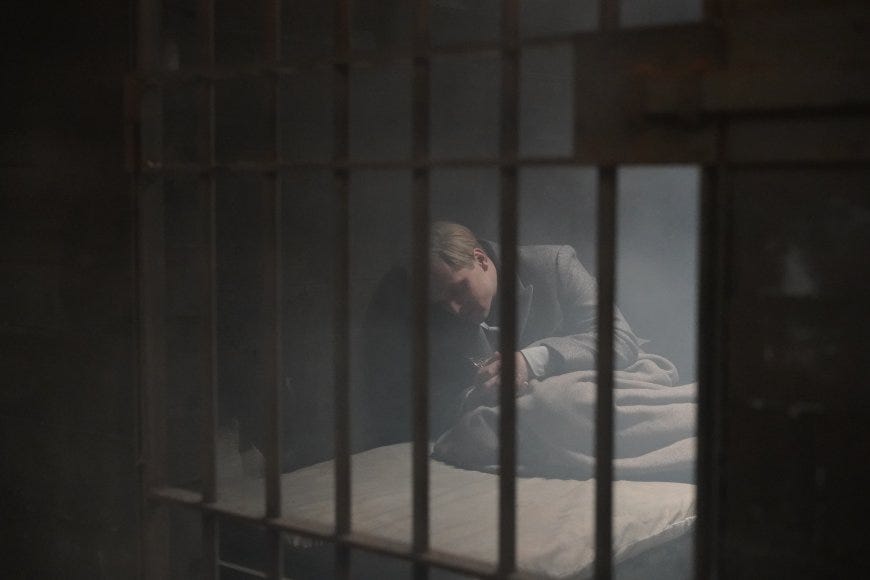
All throughout the film, we are seeing Dietrich writing in a notepad while being transported with other prisoners, it turns out, who are accused in the July 20 plot to assassinate Hitler.
Dietrich had the chance of staying in the United States to avoid Nazi Germany, but he instead chose to go back to help save millions of Jews from genocide.
Screenwriter Kornarnicki is making this his first outing as a director. He also did “The Professor and Madmen” and produced the comedy “Elf” with Will Ferrell that made $220 million worldwide and became a holiday classic.
He also scripted “Perfect Strangers” with Halle Berry and Bruce Willis and “Meet Dave” with Eddie Murphy, and wrote pilots for ABC, NBC, CBS, FOX, TNT, and Netflix.
His next directing venture is “Heart,” another true story of the only professional athlete to ever play sports with a transplanted heart.
Sit back and enjoy this gripping beautiful period piece in muted gray tones, showing the vibrant true story of a man who so forcefully yet subtly challenged the Facism invading his country. With superb acting and a tightly flowing storyline, you won’t be bored for a moment.
###

 Dreamweaverarts
You must be logged in to post a comment.